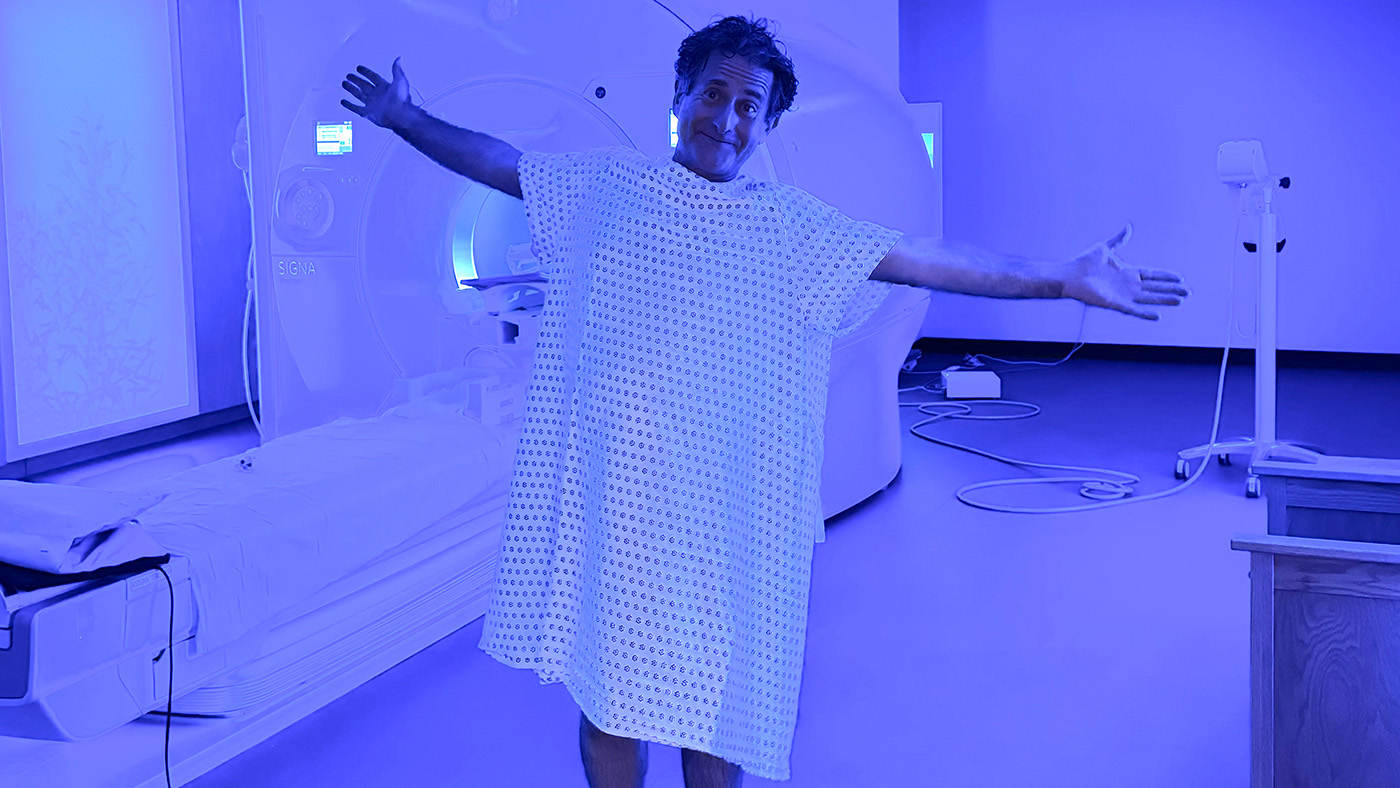
What My Full-Body Imaging Revealed
Two weeks after getting a full-body scan, the radiologist from SimonMed Imaging teleconferenced me about my results. There were “just two trouble spots,” he said; one in my brain and the other in my liver. I readjusted my desk chair and began mentally getting my affairs in order.
The U.S. healthcare system expects us to wait until the symptoms of whatever horrible diseases we have unwittingly incubated announce themselves so loudly that battling them—and often losing—will replace whatever we wanted to do with the rest of our lives.
“We’re shifting healthcare from reactive to proactive,” Dr. Sean Raj, SimonMed’s chief medical officer, told me before my scan. “We’re incredibly good at treating disease once we know there’s a disease, but we’re not great at identifying that disease early, when it’s the most treatable.”
Full-body scans are trending among people who prefer not to die of preventable diseases or surprise aneurysms. One company even advertised its scan on the last Super Bowl—the same one that was featured on Keeping Up With the Kardashians.
I chose SimonMed instead because they were the only imaging company to reply to my email. (Nice job, SimonMed publicity department! Who needs Kim when you’ve got me?)
A full-body scan with SimonMed normally runs $2,500—money I would only have lying around if I started selling my plasma or foot-fetish photos. But there are cheaper options. It’s $900 for a neck-to-privates scan and $1,500 if you want to also throw in the head. (A full-body scan also includes the spine.)
Oops, I interrupted Dr. Raj, who was still speaking.
“The whole point of this exam is to evaluate you when you’re in a healthy state, to look for any signal that could be concerning before it gets downstream into a big problem for you,” he continued. “Because if we identify disease early, then treating it becomes much, much easier for the patient.”
Yes, but there’s also an upside to remaining in the dark about your future health …
The Scan Who Knew Too Much
Fast-growing, operable cancers and secret aneurysms aren’t the only things caught by scans. Slowly developing cancers and untreatable conditions that might not manifest themselves for decades may also show up.
Why would anyone want to know about those? Unawareness allows for added decades of enjoying life instead of being sickened and financially depleted by interventions, such as surgery, chemo and radiation, that might not work. Or, almost as bad, they might be unnecessary because the ailment wouldn’t have killed you.
To settle this existential debate, I consulted someone who considers herself more of an expert than anyone: my mother, the voice inside my head since … well, since I formed a head.
“Your father never wanted to do anything like this,” she said during a rare interview with the media. “He always said that people develop little things they don’t have to know about because it won’t kill them, and that what does kill them is something they don’t expect.”
My father certainly didn’t expect the Parkinson’s with Lewy body dementia that began erasing him at age 80. Every male in his family was already dead of a heart attack by 67. And, since there was no effective treatment for his condition, he couldn’t have done anything with an earlier diagnosis other than not enjoy his last functional decade.
Nevertheless, I wanted to know.
Screen Test
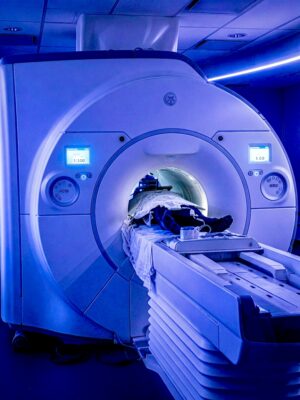
Photo | SimonMed
The scan felt more like a one-hour spa treatment. Lying face-up on a padded tray, I was slid in and out of the biggest, most modern MRI I had ever seen.
“Three Teslas—twice the power of most MRI magnets,” the radiographer said.
All I noticed was an MRI hole twice as large and thin as any I ever stared up into, which meant almost none of the usual claustrophobia.
A relaxing video calmed my dread about what the scan WOULD find. I watched it courtesy of a mirror reflecting a YouTube video into my line of sight from a TV on the back wall. Headphones, which were placed over the foam plugs that protected my ears from the MRI noise, blasted ’80s rock music that I selected from the available menu.
As the scan began, I watched hang-glider pilots soar over the cliffs of Oahu, Hawaii, to Hall & Oates’ “Out of Touch” and Aerosmith’s “Dude Looks Like a Lady.”
“Hold your breath,” the machine commanded in a robotic female voice—like Siri if she became my yoga
teacher. “1, 2, 3, 4, 5, 6, 7. Relax.”
It was hard not to.
Full Body of Evidence
By this point, you’ve most likely deduced that my two “trouble spots” weren’t anything serious—or I’m a terrible writer for waiting this long to tell you.
As the radiologist showed me the relevant MRI slices, he assured me that both white dots were either cholesterol deposits or benign cysts, and they were “nothing at all to worry about.”
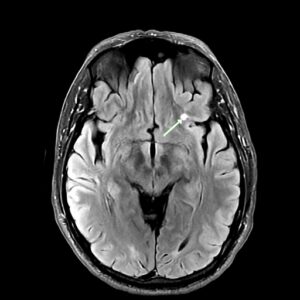
Photo | SimonMed
“Cancer would have revealed itself via diffusion,” he explained, toggling between two brain slices to demonstrate that the spot appeared identical on both.
“Most people your age actually have three or four more of these spots than you do,” he added. “You’re good.”
Some other things I don’t have are heart, thyroid, liver or kidney disease, at least for now.
But not every full-body “scanee” is this lucky. According to a 2005 study published in the journal Radiology, about 37% of full-body scans revealed at least one trouble spot that didn’t resolve with diffusion. Furthermore, intrusive testing was required for a diagnosis. And therein lies the dilemma that Kim Kardashian never mentioned.
Don’t get me wrong. I am grateful to know that, at least for the next 10-20 years, I’m most likely to die in a traffic accident, from the next pandemic or of spousal murder. (My wife is a former private detective and absolutely knows how to get away with it.)
But I just rolled the informational dice and got lucky.
Oh, and when I asked the radiologist whether I had any signs of Parkinson’s, he said an MRI wasn’t the right type of scan to check for that.
Honestly? That was the best news of all.