The Creative Journey of Mario Basner
Mario Basner has enjoyed two distinctly different creative careers that stimulate the senses and evoke emotions. Whether making music or photographing some of the world’s most stunning architectural treasures, Basner has always been passionate about touching the hearts of his audiences.
His artwork, which inspires introspection and reverence, received significant international acclaim when it was exhibited at the 2019 Venice Biennale in Italy. In this first of three articles about Mario Basner, STNDRDS provides a glimpse of the man behind the camera.

Rypka: What three words describe who you are?
Basner: Emotional, purposeful, complicated.
MR: Where did you grow up?
MB: In a small village near Hamburg, Germany. My childhood was idyllic in a cultural town, where my playground was a huge forest that had a castle.
MR: What did you do before you became a world-renowned photographer?
MB: I was in demand as a drummer in Germany, Switzerland and Austria, where I played in the European tours of Broadway shows. Those theatrical productions usually took place in beautiful, historic buildings.
That’s why, years later, I was eager to photograph the grandeur of buildings like the Palais Garnier opera house in Paris; monastery libraries like the Abbey Library of St. Gall in Switzerland; Trinity College Library in Dublin; and the George Peabody Library in Baltimore.
MR: Why did you move to America?
MB: Something important was missing. I needed a challenge in order to grow, so I moved to LA in 1995. My transition from music to photography began when I met one of the top celebrity headshot photographers in Hollywood, who mentored me and got me a job at one of the biggest photo labs in LA.
People brought in priceless original negatives of legends like Greta Garbo, and I’d make large, stunning black-and-white prints. That’s when I began to get serious about photography and opened my own professional darkroom.
In 2005, I moved to Las Vegas and worked as a drummer in Mama Mia and The Lion King on the Strip. In 2010, I met my wife, Deanna, who is Canadian.

MR: Your photographs at the Basner Fine Art gallery in Tivoli Village look more like paintings.
MB: It took me two years to develop that technique. We have various sizes, the largest being 7.5 feet wide. I wanted to create a portal so it felt like you could step inside the artwork.
MR: I can’t wait to hear all the stories about your experiences photographing the most iconic buildings, some which are UNESCO World Heritage Sites. Give us a taste of what’s to come by telling us about photographing the casks in the cellars of Louis XIII Cognac in France.
MB: At a Las Vegas event, I met Marie-Amélie de Leusse, the granddaughter of the family who owns Rémy Cointreau, which has made Louis XIII Cognac—the crown jewel of the House of Rémy Martin—since 1874.
She is also the chairman of the company. She came to my gallery, and we met again in Paris, where she lives. Over a glass of wine at the Ritz Hotel, the subject of me photographing the casks in the cellars of Louis XIII Cognac came up, and Marie-Amélie invited me to her estate in Cognac.
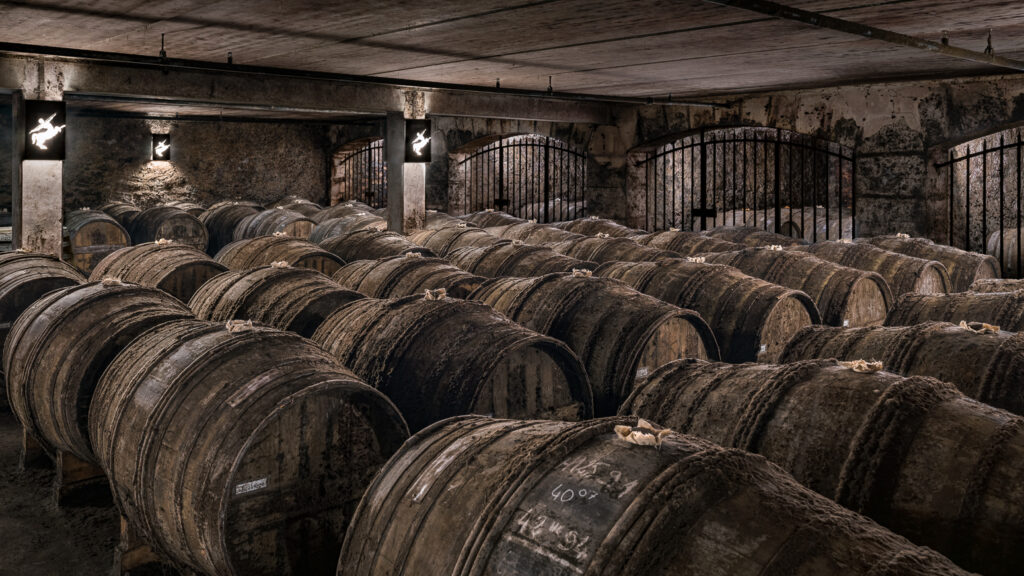
Being European, I especially appreciate the company’s highest standards, their commitment to excellence and their tradition of aging the Cognac for 100 years in Limousin oak casks, which have the perfect tannins and porosity.
I was honored to be invited there because no photographer had been allowed in since the 1960s.
It was so dark in the cellar, I couldn’t see anything. I was worried the photo wouldn’t turn out. The normal exposure time in low-light situations is often one to two seconds, while long exposures generally start around 30 seconds.
I had to do the math and calculate the exposure time, not knowing what would work. I was in the cellar alone—Marie-Amélie and my wife, Deanna, were waiting upstairs. I took my best guess: eight minutes, which seemed like forever. Thankfully, the photo came out great, and afterward the three of us enjoyed some Cognac right out of the barrel.
MR: It’s been an extraordinary journey.
MB: It has. I was searching a long time for purpose and meaning in my life, not knowing what I was looking for. Then I did my first big photo shoot at a former health sanatorium near Berlin built in 1898 that had long since been abandoned.
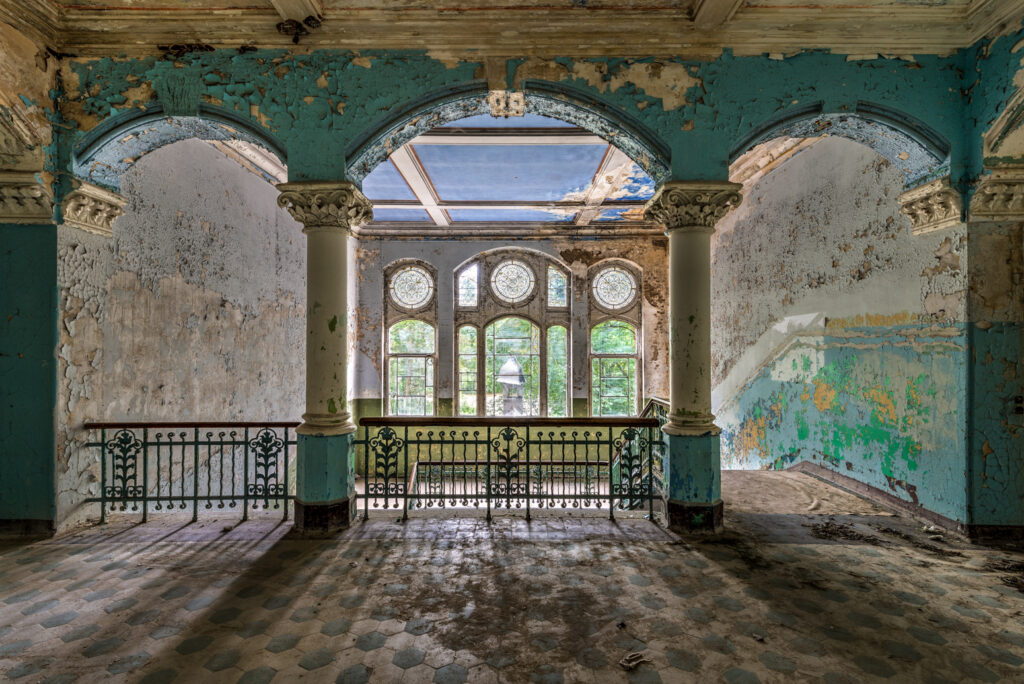
I expected to find empty buildings and have an interesting experience. But the moment I stepped into the first room, I found everything I’d been searching for. Even though the paint had peeled and the walls were all mottled, I was able to capture the beauty of the architecture in a way that profoundly changed me. But that’s another story for another time.
You can view Mario’s work by visiting basnerfineart.com.