
I’m generally a calm person. I mean, please don’t check with my wife about that. She overhears the distinct lack of calm I display whenever I have to deal with customer support over the phone.
There is something about waiting on hold for 40 minutes to speak to someone who, it turns out, is not in the correct department. Then having to repeat that entire process four more times drives me beyond my control to not raise my voice like a lunatic.
My frustration is actually with a corporate policy that has a name. “Sludge” was coined by Nobel laureate behavioral economist Richard Thaler in “Nudge, not sludge,” an August 2018 editorial he published in Science, the American Association for the Advancement of Science journal. It describes the deliberate bureaucratic friction introduced by greedy corporations to make canceling services or accessing benefits intentionally difficult.
Sludge saves these corporations millions of dollars per quarter. But karma doesn’t care how wrong our greedy cable, phone and internet companies are. It only knows how wrong I was for going all Goodfellas Joe Pesci on the poor exploited souls forced to work for them—which led to a lesson I will take to the grave.
A few years back, I called Cox Communications because my cable kept crapping out during movies I couldn’t finish yet always got fully charged for. The company had already sent out two technicians to tell me they couldn’t find a problem and that I must be mistaken.
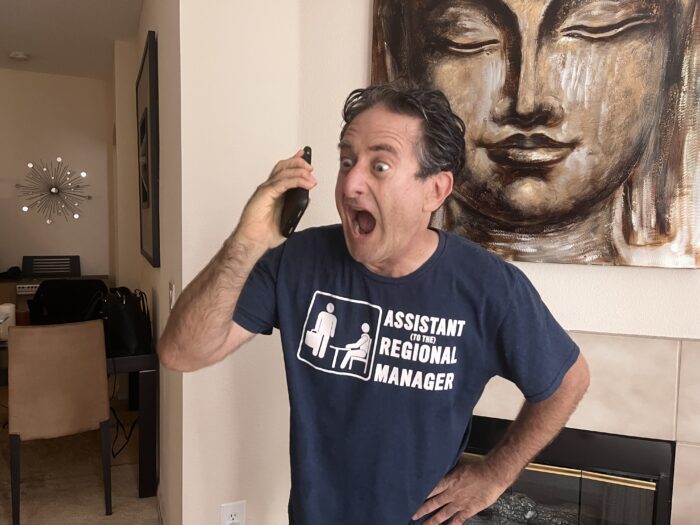
Here I am, going full Goodfellas Joe Pesci on a time-wasting customer support call and ignoring the Buddha painting in my living room.
Once I got a representative on the phone for the third time, I said things. Terrible things that I’m not proud of in retrospect. They involved the company’s name and various anatomical interpretations of it. At the time, though, it felt like I was one of the fed-up masses who opened his windows and yelled, “I’m mad as hell, and I’m not going to take this anymore!” during the 1976 film Network.
Then something beyond the realm of possibility happened to me. I received a Facebook DM.
“Corey, is this you?” it read. It came not only from someone I knew, but someone I had hoped to get to know better.

Ernest Hemmings is a playwright and performing artist whose experimental works have been produced in theaters across the country.
Ernest Hemmings is the most creative playwright I ever met. He directs and stars in sketch-based theatrical fever dreams fusing a deep social conviction with a fetish for ’50s pop culture and sadistic humor. I interviewed him once for a story, and we ended up joking off the record for half an hour.
That had never happened to me before or since. I added him to my social media immediately, because when you meet a creative soulmate, you cling like a barnacle.
And my new creative soulmate was the Cox operator whom I had just verbally torn a new butthole. This was a scene from one of Hemmings’ plays. What were the odds of this happening in real life? It was similar to flipping off a motorist who turns out to be the new boss you’re about to meet. If I saw it in a sitcom, I would have switched it off for being too contrived.
Hemmings is such a better person than I am. He even felt the need to offer me plausible deniability. BUT Of course that was me he was talking to—my unique full name was right on the screen in front of him!
I avoided him for months. I avoided 800 numbers. I avoided mirrors. My tirade kept playing over and over in my head, as every operator I’d ever vented at suddenly sprouted a face, a family and a week I had genuinely ruined.
But Ernest? He shrugged it off. He kept commenting on my posts. He even invited me to his daughter’s birthday party.
Eventually, I took my wife to see his latest play. He offered to comp the tickets, but I insisted on paying because guilt is expensive. The show featured a sketch in which one of Hemmings’ characters screamed into a phone at a sentient Siri app using phrases eerily similar to the ones I had hurled at him.
My wife elbowed me to ask why I wasn’t laughing. The reason was that it felt more like an intervention than art. At the conclusion of the scene, Siri called the cops and had the character arrested for verbal abuse.
After the show, I had to ask Ernest.
“I wasn’t thinking about you in particular,” he replied as I helped him carry a 60-pound audio mixer to his car like a man performing penance in a medieval morality play.
Notice how he qualified his statement with “in particular”? I did.
Anyway, I don’t yell at customer service people anymore. OK—well, I try not to.