Ancient Medicinal Plants Make for a Pleasurable, Calming Cuppa
We’re all well aware of tea mainstays like English Breakfast and Japanese matcha—especially if you prefer to indulge in a leafy cuppa instead of a steamy mug of coffee every day. But for a truly unique brew, we need only to look north, to the United States’ friendly chapeau (hat), Canada.
Indigenous populations have lived in Canada for more than 16,000 years, surviving off the land they planted and harvested, as well as embracing the medicinal properties of herbs endemic to the provinces. Today, First Nations people have brought those herbs to the forefront by way of tea, introducing all of us to unique flavors you can’t get anywhere else.
Have you ever tasted Labrador in a cup; or the leaf of a raspberry instead of the berry itself? Well, now you can. Below you’ll find tea producers from five different provinces that are ready to ship you a sip of Canadian history.
The Yukon
According to herbalist Beverley Gray, owner of Aroma Borealis in Whitehorse, The Yukon, the northern boreal forest truly communicates the spirit of place. You can feel it when you wander the mountainsides, forests and prairies of this subarctic ecosystem. It becomes something almost sacred—so it’s especially important that all the medicinal herbs carpeting the landscape be wild harvested with care.
From balsam poplar buds and spruce tips, to fireweed and rose hips, the harvesting team gives thanks to the land—the ancestral territories of the Carcross/Tagish First Nation, Kwanlin Dün First Nation and the Ta’an Kwäch’än Council—alongside every clipping.
For a taste of the trees themselves, brew up a spoonful of Aroma’s Spruce Tip Tea and enjoy the resinous, bright flavor. Or, embrace the tartness of wild rose hips with a bag of Rosehip Tea. For a blended cup, the eponymous Aroma Borealis blend contains rose hips, blueberries, nettle, oatstraw, lemongrass and cornflower.
The Spirit of the Boreal blend brings the true essence of the boreal forest to life in your cup with a blend of Labrador, spruce tips, fireweed, nettle and peppermint. Careful if you’re expecting, though; Labrador tea is not recommended during pregnancy.
British Columbia
Raven & Hummingbird Tea Co., based in West Vancouver, British Columbia, is a multigenerational family business owned by members of the Squamish Nation: T’uy’t’tanat Cease Wyss, her daughter Senaqwila Wyss, and her daughter’s partner, Justin Leo.
Together the group has spent more than 30 years studying ethnobotany, medicinal herbs and Indigenous plants. The ingredients for each tea are harvested, dried and blended by the company owners, and they work to pass on the Squamish plant names for each of the components as well.
Raven & Hummingbird’s team hopes each cup represents not just intergenerational knowledge transfer, but also the relationship we all share with the land and our languages.
Though the company has a large selection of tea blends, it has two signature family-created options. Kanaka Ranch honors an urban farm from the late 1800s and blends stinging nettles, rose hips, ginger root and hibiscus flowers. Strengthen Me focuses on the rich mineral contents of each ingredient, combining stinging nettles, raspberry leaf, mint and rose hips.
Saskatchewan
Operating on the ancestral Saskatchewan lands of the Woodlands Cree, Métis, Plains Cree, Dene and Saulteaux, Boreal Heartland in Air Ronge, Saskatchewan, works in concert with the Keewatin Community Development Association nonprofit organization. It strives to support both the residents of the northern section of the province, as well as the boreal forest itself. Boreal Heartland makes four tea blends, with an aim of bringing Indigenous flavors to the masses but in a way that today’s palate finds pleasing.
You can buy a four-pack of the tea blends on the Boreal Heartland website or purchase a single blend. Choose from Restoration Tea made with fireweed and mint; Relaxation Tea with Labrador, goldenrod and nettle; Energization Tea made with wild sarsaparilla root, rose hip, bearberry and birch leaf; and plain loose-leaf Labrador Tea.
Ontario
Ojibwe woman Denise Atkinson and her partner, Marc Bohémier, founded Tea Horse in 2017 on the territorial lands of the Anishinaabe Peoples in northwestern Ontario. The company offers a selection of standard teas, including Earl Grey, Rooibos, Sencha Green and standard breakfast Black Tea.
But Tea Horse specializes in something rather unique aside from those—tea made with roasted wild rice, known as manoomin in the Ojibwe language. Manoomin is a spiritual staple for the Ojibwe peoples and is mentioned in oral tradition as the reason the Indigenous group settled in the Great Lakes region.
Tea Horse offers three manoomin teas. Caffeine-free Manoominaaboo Tisane is simply the roasted wild rice on its own. ManoominChai blends roasted wild rice with black tea and masala spices. The third option, ManoominCha, is a mix of roasted wild rice and green tea.
Quebec
Délices Boréal sources all the ingredients for its tea from Nunavik, the northern third of Quebec, land governed by the arctic Inuit peoples. The climate is harsh, and the local plants have had to learn to adapt to intense sunlight, bitter cold and heavy winds. All the tea ingredients are harvested, cleaned and dried by hand, then shipped off to Montréal to be blended with different tea varietals. Each of the five blends can be purchased separately, with the boxes emblazoned with the Inuit word for the main herb or berry.
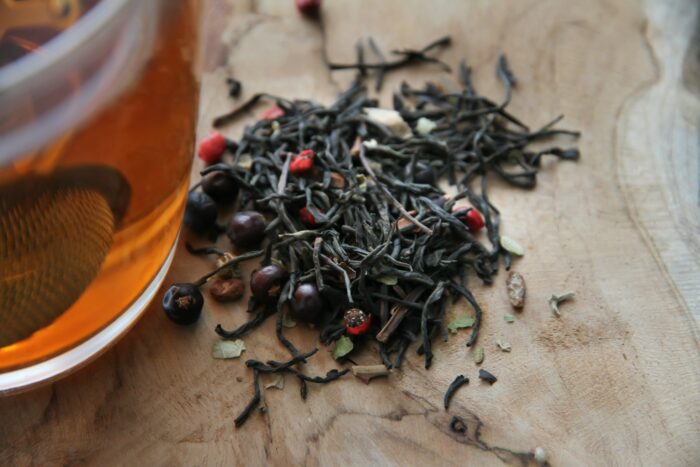
Paurnagaqutik, or crowberry, is particularly unique to the region. The blend is a robust violet color from the deeply hued ingredients: hibiscus flowers, lemongrass, birch leaves, crowberry leaves, juniper berries, cinnamon bark, red poppy flowers, star anise, licorice root and cloves.
For another regional specialty, try the Arpiqutik (cloudberry) blend. The delicate berries’ leaves are used for this tea, in addition to sarsaparilla root, fenugreek seeds, carob, roasted chicory root, cinnamon bark and roasted mate, leading to a flavor reminiscent of Canada’s iconic maple tree.