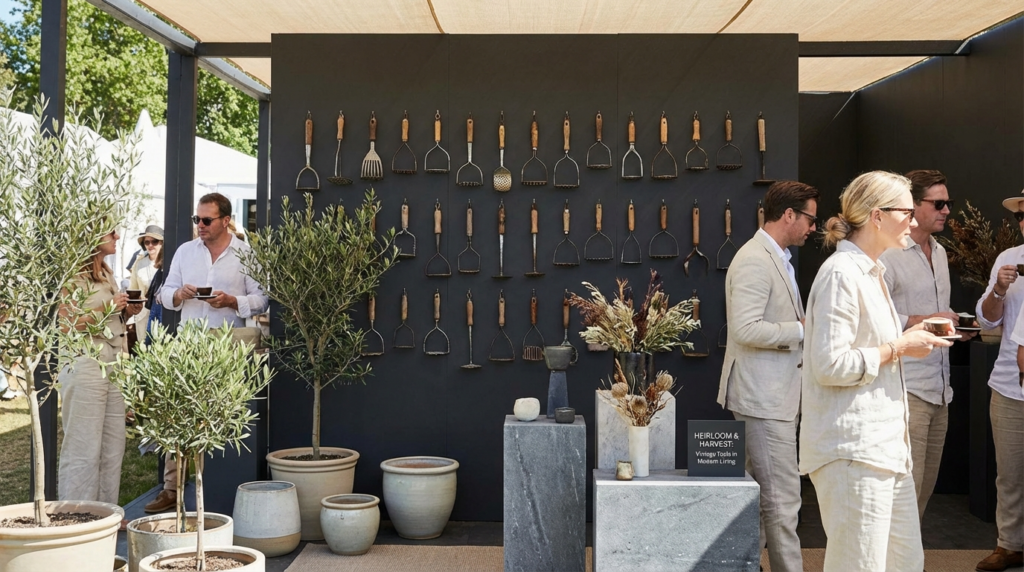
At the recent Antiques & Garden Show of Nashville held in Tennessee, a dealer named Erik Retzer did something unique. He hung a set of European hand-turned wood potato mashers from the late 1800s on the wall of his booth. The sort of thing your great-grandmother would have used without a second thought, then shoved in a drawer.
People stopped. They looked. They bought them.
“They are items that were never meant to be art,” Retzer, founder of the Chicago-based Right | Proper boutique, is quoted as saying. “But when you mount them on a wall, they become like a beautiful sculpture, perfect in a kitchen, a restaurant, or even a hotel.”
This is the sort of statement that would have sounded ridiculous a decade ago. Potato mashers as sculpture. Wooden mallets as gallery art. And yet here we are, watching antique kitchen tools get the sort of attention once reserved for midcentury furniture and Danish credenzas.
The Shift
Behind this trend isn’t nostalgia, per se. It’s something more complicated: a collective tiredness with the sleek, the optimized, the algorithmically optimal. After years of minimalist kitchens that look like they’ve never been used, people are hungry for signs of human touch. Of work. Of time.
French copperware, once the province of Julia Child enthusiasts, has become a statement piece. Martha Stewart’s collection of vintage copper, suspended from an overhead track in her kitchen, has been analyzed ad nauseam by interior design magazines.
Giorgio Armani‘s kitchen is dominated by an entire wall of antique copper, displayed like museum artifacts. The distressed patina, the scratches and scuffs, the marks of closed manufactories: These are the elements that now sell for thousands.
Function Reconsidered
The potato masher is a fascinating example. The aesthetic has remained the same since the 1860s. Whether hand cut from a piece of wood in rural Estonia or turned on a machine in an American factory, the design is the same: a handle, a weight, a function.
What collectors and designers are responding to now is exactly that functionality. A potato masher from 1890 does exactly the same thing as one from 2026. But the former has a century of history in its patina. The wood has aged. The edges have softened. It has a story to tell without needing explanation.
This is what Retzer is getting at when he talks about objects that are “never meant to be art.” The people who made these objects weren’t thinking about beauty. They were thinking about dinner. The beauty is incidental, which may be why it looks so authentic.
The Copper Obsession
French copper from the vintage era is a slightly different story. It was always beautiful. And that was part of the point.
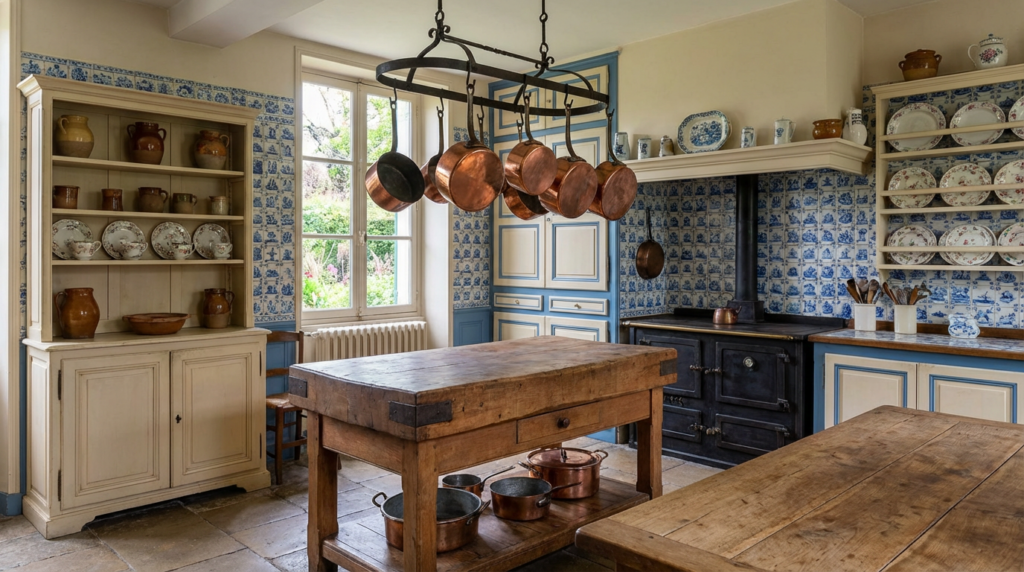
The great French cookware manufacturers of the 19th century, companies like Mauviel1830 and E. Dehillerin, were making for grand Parisian restaurants, households with servants, and people who cared about the look of things as well as their function.
But even in this case, the desire is shifting. The buyers who are willing to pay $2,000 or more for a single pan aren’t just home cooks. They’re people who want to display these items on walls and open shelving as the focal point of a room.
A pan that has cooked thousands of meals carries that history with it. The tin lining, the brass rivets, the handle worn smooth by hands: These are the hallmarks of authenticity that no amount of distressing can capture.
What It Means
There’s also a larger cultural narrative at play. The vintage kitchenware revival is part of the same movement as the slow food revival, the “anti-plastic” campaigns, the desire for objects that will outlast us.
It’s also a statement against the Instagram kitchen, the gleaming expanse of white marble and invisible appliances that seem designed solely for the purpose of photographing rather than cooking. People want to see signs of life. Of meals eaten. Of hands at work.
Whether this is a true shift in values or simply the next step in the never-ending cycle of taste is difficult to say. Trends come and go. What’s valuable becomes worthless—and vice versa.
But the notion of a potato masher as art is somehow appealing. The idea that beauty can be found in places we’ve been taught to look away from has been realized.
That the objects most proximate to our daily lives, the ones we use without thinking, are not necessarily the ones most worth saving. That a wooden mallet crafted by an unknown hand 150 years ago can hang on a wall and hold its own against anything you might find in an art gallery.
The best things, it turns out, are often the ones that never set out to be anything other than what they are.