Silicon Valley’s Elite Embrace Beautiful Repair
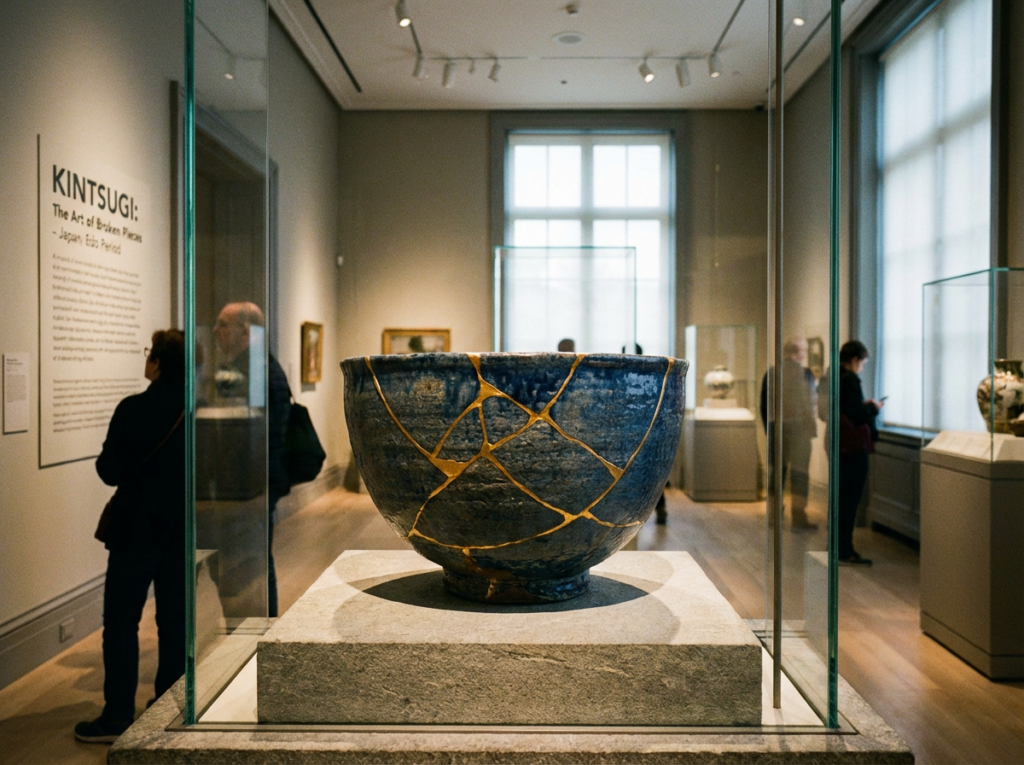
In the whisper-quiet galleries of Tokyo, collectors pay top dollar for chipped and smashed ceramics that have been repaired using seams of lustrous gold. This is the centuries-old pottery art known as “kintsugi” (golden joinery).
Kintsugi is based on an underlying philosophy that’s foreign to our modern aspiration toward faultlessness. The breakage and repair are simply part of the history of an object, rather than a cause for discarding or replacing it.
The process has slowly and quietly seeped into the daily rituals of everyone from tech founders and venture capitalists in Palo Alto, California, to creative directors in Brooklyn, New York.
It started as a 15th-century repair method, but became common on today’s social media platforms, including YouTube and Instagram. But this isn’t about pottery. Not really.
The philosophy underpinning kintsugi of revealing the history of an object once broken, rather than disguising its repair, is being applied to everything from career pivots to relationships—and even to our relationship with aging itself.
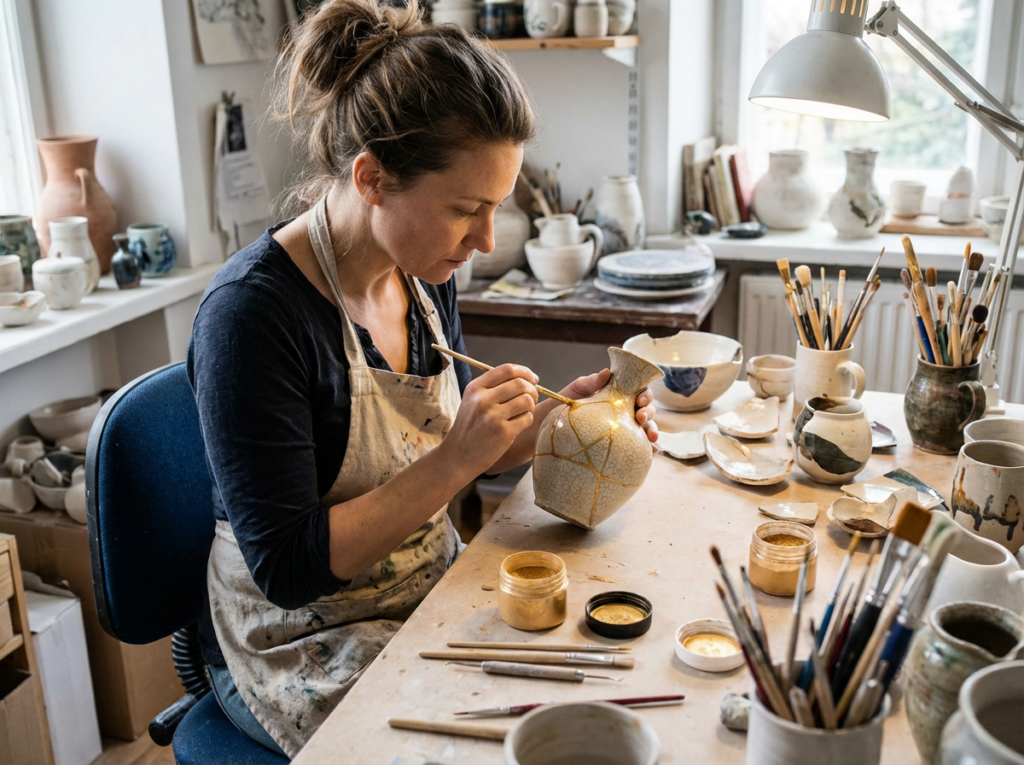
It’s a counternarrative to our culture’s worship of perfection; its reverence for the permanently optimized self.
“It took 20 years to look like I was unbreakable,” Marcus Chen confided. A former partner at Sequoia Capital, he now teaches practices in contemplative leadership in Northern California’s Marin County.
“Kintsugi showed me that my most precious learnings came from the places I broke: the bad acquisition, the divorce, the depression that I white-knuckled through (in) boardrooms.”
Chen isn’t alone. A tiny but expanding cadre of Japan’s so-called-high-performance elite have been making pilgrimages to Kyoto kintsugi masters. They go not just to learn the forms, but to set foot on what practitioners refer to as “kintsukuroi,” or kintsugi, consciousness, a fundamentally different orientation toward impermanence and change.
The work itself is meticulous: shards of pottery are reconstructed using a mixture of “urushi” (tree sap) lacquer and crushed gold, silver or platinum.
The process can take months. Every golden seam serves as a reminder of the breakable becoming desirable; it creates a visual history of life surviving.
One of these masters, Shokunin Takahashi Setsuko, is a fifth-generation kintsugi artist whose waiting list is filled with names that are recognizable from Forbes magazine lists. People have flown in from Taiwan just to see her.
“In the West, they think about the concept of good as new. With kintsugi, we have ‘better than new.’ The breaking is the start of value, not its end,” she explained.
It’s not just institutions that are being transformed by this philosophy. It’s starting to creep into some unexpected corners of contemporary life too.
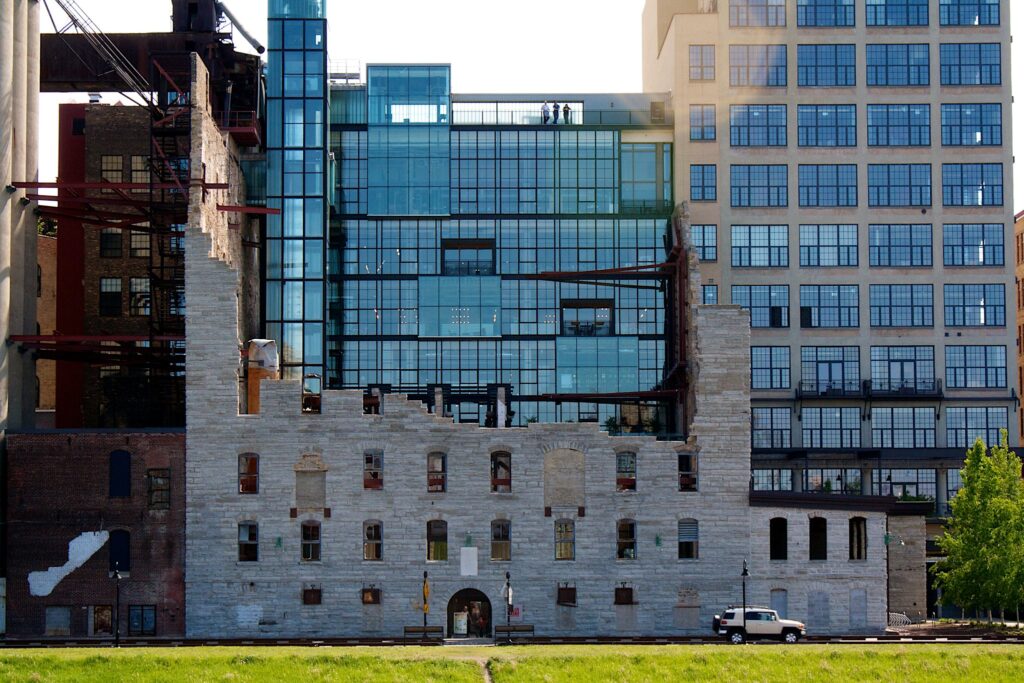
Architects are creating kintsugi homes and structures that celebrate structural repairs with contrasting materials, such as exposed bronze joinery in earthquake-retrofitted walls, other patches of daylight brass in heritage plaster.
And fashion designers like Mayumi Sato are posing collections in which visible mending is not done out of necessity but aspiration, with elaborate gold-thread stitches serving strangely as a garment’s main design element.
Even the world of wellness—never one to let a metaphor slip through its fingers if they don’t have to—unapologetically co-opted the language, if not always the spirit.
Kintsugi therapy sessions vow to support clients in “gold plating their trauma.” Retreat centers in Big Sur, California, and Sedona, Arizona, conduct weekend intensives where participants break and then repair ceramics as a surrogate for their own transformation.
The cynic might shrug and say that this was just another Eastern tradition repackaged for Western consumption, like mindfulness apps and adaptogenic lattes. There’s truth to that critique. Real kintsugi takes years of practice; the Instagram-ready version can be done in an afternoon with craft-store epoxy and gold leaf.
But maybe what travels is not the technique so much as the permission it allows. In an age of curated perfection, when even our breakfast is staged for optimal lighting, kintsugi represents a new kind of luxury. The freedom to be beautifully incomplete.
The novelist Claire Messud lived in Kanazawa, Japan, for six months while apprenticing herself to a kintsugi master.
“We’re so afraid of being found out as fakes; as people who turned out not to have been equal to the challenge. That we couldn’t do what was expected of us,” Messud described. “Kintsugi says: show the cracks. Make them gorgeous. Let them tell your story.”
The trend has to some extent even shaped how certain people are now handling the delicate business of aging. As the antiaging industrial complex rakes in billions getting us to erase every line and sag, followers of this Japanese craft ask a different question: What if we shone a light on our cracks instead of trying to cover them up?
It’s a radical proposition in a culture that reveres youth and erasure. But then again, the most radical act of our time might just be to understand that while brokenness is not wholeness, it is still beautiful.
It may be time to take the seat at the table once inhabited by a smug and shallow optimism with which one could rhapsodize about greatness, while ignoring all that isn’t great or glorious. And, in the seat where one might finally say, as in Psalm 34, “Taste and see,” recognizing how bitterness has its own peculiar richness.
Not in spite of the fractures, but because of them.