After more than two decades with the woman I love, I have come to a humbling realization: I am a terrible couple half. Not in the forgetting-anniversaries way; though I’ve definitely forgotten those. My particular brand of relationship incompetence is far more insidious, embarrassing and grammatically criminal.
Our society is consumed by the politics of personal pronouns, but I have a problem with the one that is almost universally accepted. I do not use the word we. I avoid it like a summons server even when it is obvious, morally correct and socially required. Most normal humans in long-term relationships glide into the plural first-person like it’s a warm bath:
“We love that new bistro.”
“We’re thinking of Maui next summer.”
“We don’t talk about the knife incident.”
I hate those couples, by the way. Left to my own instincts, I speak like a feral bachelor who accidentally wandered into a 20-year relationship and decided to stay because of the foot rubs. This is especially true on social media:
“I’m going to L.A. next week.”
“I can’t believe I have a teenage daughter.”
“I hated Marty Surpreme.”
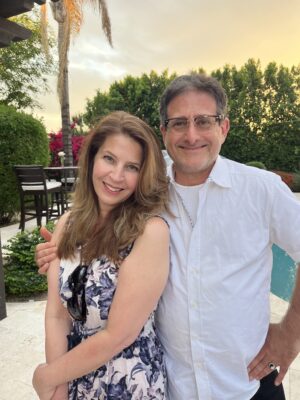
My wife, with her Gandhi-like tolerance, will sometimes—but not even always—offer a gentle correction. She didn’t with my Marty Supreme pronouncement, but only because she loved the movie; an entirely different marital crisis we had to navigate privately.
“It’s the two of us, honey,” she’ll remind me with the calm tone of a hostage negotiator. “We’re a unit. We’re people who share a mortgage, a Costco membership and a child.” (I may have misremembered how she ordered those.)
It’s not that I don’t feel coupled. I do. I love being in love with someone who knows exactly how I like my lovemaking and my matcha—both hot and with vigorous whisking—and exactly how long I can tolerate any social gathering before scanning for exit doors.
Yet, when it comes to the simple act of self-description, my brain defaults to single-player mode. I am a glitchy, first-generation Xbox that won’t pair with Bluetooth.
Part of the problem, I suspect, is occupational hazard. I tend to narrate life like the columnist I am. Everything in my universe must pass through the lens of my perspective. My neuroses. My tirades at customer-service operators. My ongoing cold war with the overly enthusiastic Trader Joe’s checkout cult.
To my broken brain,saying we feels like a forced shared byline; something handed down by an editor who didn’t think my voice was strong enough to carry the column by itself.
OK, OK, using my craft as a crutch is a total cop-out. The terrifying truth is that my internal self-concept is still stuck on the 15‑year‑old version of me. And 15‑year‑olds don’t say we unless they’re in a boy band.
I really do try to evolve. Occasionally, I’ll even start a sentence with we. And then I’ll immediately panic, like I’ve been assimilated by the Borg from Star Trek: The Next Generation, and my individuality no longer exists. If I can make it all the way through the sentence, I will expect a parade. But the second I stop thinking about it, my software reverts to its I factory setting.
My wife, to her immense credit, has never weaponized my we problem. She doesn’t accuse me of emotional distance or commitment issues, even though both traits always loiter nearby like deadbeat roommates. I know I don’t deserve her. Even if I didn’t own any mirrors, I would have a profound awareness of how lucky I am.
I’m trying. I really am. I want to want to be a we person. I want to want to be one of those couples who speak in harmonious plurals. I’ll even prove it right now. I will end this column on a public, legally binding commitment, a linguistic vow to solve my personal pronoun problem: We are working on this.